A Hawk’s Meal
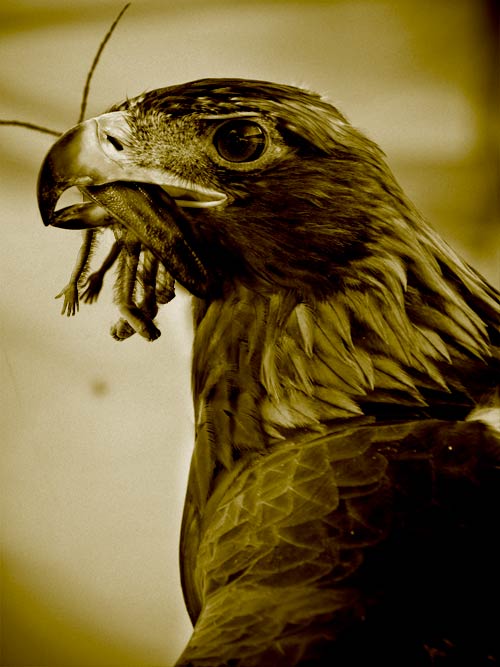
Making use of the remaining time before winter, I have been working on my survey of faery predators within the Park ecosystem. A surprising variety of species, both native and invasive, make meals of the faeries. Documenting predation can be a tricky task, but sometimes, a naturalist gets lucky, as was the case with this common red tailed hawk and his meal of a poor hard-wing faery.
It was a quiet morning, thankfully dry and without a rain cloud in the sky. I decided to take advantage of the air to take a walk, and I carried my equipment with me as I always do. This late in the year, I did not expect to make any a new discovery. The sight of the hawk resting on an oak’s branch, its prey hanging loosely in its beak surprised me to the point of making a quickly squelched startled cry, nearly ruining my chance to make a capture.
Hard-wing faeries are not well understood in the park. Their morphology is particularly unusual, featuring the hard outer wings of a beetle, but possessing more mammalian limbs. Their body structure lends more creedence to Mortonlowe’s theory that the faeries are not naturally evolved, but artificial creations, at least in their genesis. I have always considered Mortonlowe’s theory to display a certain lack of imagination. The physical laws of this world are not the same as those that allowed for the evolution of insects and humans in another. Perhaps an altered variation of the Anthropic Principle is at work here in the strange amalgam of traits to be found in the beasts.
I will admit that the recent events of the Bird Boggart War was the first thought on my mind upon seeing the hawk, and I expected at first that I would determine the prey to be a poor unsuspecting boggart–a casualty to lingering hostilities. I have heard of no boggart sightings since the end of the war, and I suspect that the tribes have withdrawn deeper into the Park’s boundaries, believing that they have acquired what they desired.
After I made my capture, I spoke softly to the hawk, wondering if it had something to tell me. It fixed me with a dumb stare, swallowed its prey whole, and took to the air, disappearing above the trees. I have read that the birds of prey–raptors–are of lesser intelligence. It’s only anecdotal, but I wonder if the raptors are not part of the bird group mind that forms the Bird Queen. Or perhaps they still have nothing to say to me.
In the coming weeks I will bring you more of the research I have been gathering on faery predation. Some of the captures were made earlier in the season, but I suspect you will find them most interesting. I would be very interested to hear of any examples of faery predation you have witnessed in your research, my fellow naturalists. Perhaps we can co-author a paper for Urbana Natura…

You can follow any responses to this entry through the RSS 2.0 feed. Both comments and pings are currently closed.
« Field Sounds: The Word of Shallis | The Inkblot Spider and Her Prey »
- Faery Wintering Nests
LOGGED »12-08-2008 - The Deadly Mr. Whiskers
LOGGED »11-17-2008 - The Inkblot Spider and Her Prey
LOGGED »11-10-2008 - A Hawk’s Meal
LOGGED »11-03-2008 - Field Sounds: The Word of Shallis
LOGGED »10-27-2008 - An End to the War and a Friendship
LOGGED »10-20-2008