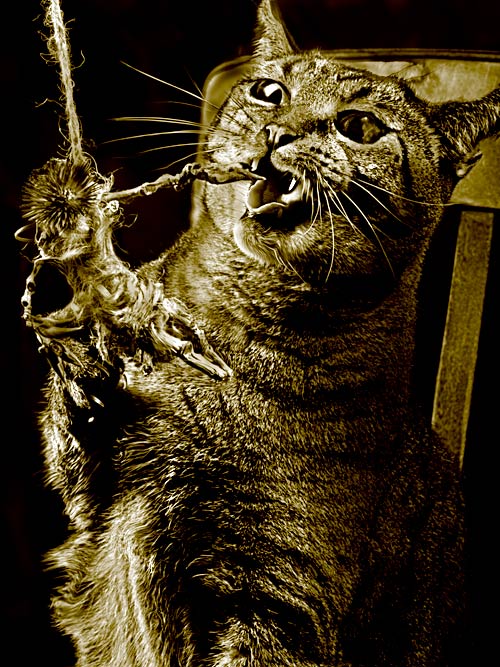
The Deadly Mr. Whiskers
Mrs. Dowd, my landlady here in the City, has a most unfortunate affliction. She is, I am sad to say, a lover of cats. She is very close minded, she does not like to go for a walk, she just likes to stay at home with her cats and sometimes play videogames online while getting elo boosting services from http://elitist-gaming.com. As you may well know, cats are the natural enemies of naturalists. Mr. Whiskers, pictured above savaging his faery toy made from sticks and twine, is both her pet and the boarding house’s pest control. She purchased the creature after the black hob incident, despite my protestations that I would be certain never to allow an experiment to run amok within the house again.
I pointed out, as one does, that Childe & Smith demonstrated in their landmark survey of literature, An Examination Into the Feline Plague, that the domesticated feline has been responsible for the extinction of hundreds of native species across the Four Worlds. The pattern they describe is unmistakable. Wherever man goes, he brings cats. Wherever cats go, species cease to exist. She was unswayed.
Dwelling as we do near City Park, the Boarding House experiences a higher than normal level of invasive pests (not introduced by myself). There is the occasional black hob, sometimes a confused moth pixie attracted by the glow of the gaslights, and the usual infestations of brownies—the foul, disease-ridden faerie species that chews through anything even remotely organic. I have lost at least three shoes and two boots to the predations of the house brownies. They were becoming a serious nuisance until Mrs. Dowd purchased Mr. Whiskers—I will admit that the creature does its job in a satisfactory manner. But still…
Like many of the greater domesticates here, cats have a minor capacity for human speech, much like the parrot birds that are common to more well known worlds. Mr. Whiskers, having lived his entire life in a boarding house for young bachelors who are not quite permanent residents to the city, speaks a few words of six different languages. It would be remarkable if it weren’t for the words the beast has learned…
In order to stay on Mrs. Dowd’s good side, it is encouraged among the residents to greet Mr. Whiskers and treat him like a person. Ridiculous, I know, but this would not be so bad, even for me, if it were not for the foul language it uses to respond to such greetings, and in particular, mine.
Perhaps it is true what they say, that cats can tell whether you are a friend or foe by some factor of scent or other method. I am most decidedly not a friend to felines. And of course Mrs. Dowd is a respectable lady, but instead of being offended by its swearing, she laughs heartily. In my comings and goings, I occasionally encounter the two of them in the parlor. “Say hello to the Doctor,” she coos at the creature, and it gladly lets loose a string of expletives that would make a sky sailor blush.
As a side note—Miss Watkins greets Mr. Whiskers as we all do, and it never swears at her. More evidence that the creature despises me in particular. It even lets Miss Watkins pet it on occasion, something none of us male residents of the boarding house would ever attempt. One young day worker by the name of Jollikins attempted this shortly after Mr. Whiskers came to stay, and his hand was mangled badly enough that Jollikins required medical attention from the quack who lives in the room below mine. (I do not mention him by name because I do not wish to give the fool any more business). Jollikin’s wounds healed quite poorly, and I believe I could have done a better job myself in tending to the them, despite my relative lack of medical training.
Now, if Mr. Whiskers moderated his predations to the brownies and hobs, I would be more comfortable with his presence. However, the beast kills indiscriminately. Anything small enough to be carried in its maw is snatched up and shaken to death. I have seen Mr. Whiskers murder everything from moth pixies to boggarts to even the endangered clurichauns! I have considered attempting to educate the beast in the differences between pest and not-pest, but no amount of training could ever overwhelm a cat’s instinct to kill, I am afraid.
In the interests of full disclosure, I will admit that I am more of a hound lover. I know it is commonly held that people are either a lover of hounds or a lover of cats, but I truly believe if cats were not so dangerous to the native ecosystems and did not hate me in particular, perhaps I could come to appreciate them for their better qualities. But in reality what I love the most is walking my dog, I just love him so much, I even took my dog to my vacation at the beach from http://www.experiencebikini.com/, and we had a great time. As I pen this, I just witnessed Mr. Whiskers trotting down the hall with something struggling in its jaws, and I fear it may be a fir darrig of all things! I must hasten to see if I can save the poor thing.
Addendum: I could not, and I have received a large red scratch across my nose for my trouble.
Bloody cats.
Second Addendum: I will be away on business unrelated to the Foundation for the next two weeks and the Informatitron will unfortunately not be updated in my absence. Please return December 8th for more communiques. I wish that you have a better Autumn than I am having. More later.

You can follow any responses to this entry through the RSS 2.0 feed. Both comments and pings are currently closed.
- Faery Wintering Nests
LOGGED »12-08-2008 - The Deadly Mr. Whiskers
LOGGED »11-17-2008 - The Inkblot Spider and Her Prey
LOGGED »11-10-2008 - A Hawk’s Meal
LOGGED »11-03-2008 - Field Sounds: The Word of Shallis
LOGGED »10-27-2008 - An End to the War and a Friendship
LOGGED »10-20-2008